Pro tips for friends and family members of cancer patients and their caregivers

Disclosure: Michael lost his battle with cancer in February 2019, but he had asked me to tell his story–our story–and so I am. You can read more about why I’m doing so here. When I originally started this blog, I wrote about events and feelings in the moment, because everything was happening so fast, and everything was chaos. Now that Michael is gone, and I’ve had the time to slow down and look back, all future posts will tell Michael’s story in a more chronologically correct order…or mostly so, no guarantees. They’ll also include some insights and commentary forged from hard-earned hindsight.

My boss for the duration of this cancer shitshow, a guy–a friend, really–named Chris, had a standing direct reports meeting each week. I remember sending a “decline” response to the calendar invitation for that meeting the week that Michael’s and my horror story was first starting to unfold. When you decline a meeting in Outlook, you can edit your response, which I did. I don’t remember exactly what I wrote, but it included the word “cancer” in it. Chris didn’t read my response. I know this for two reasons. First, he was (still is) my friend, and if he’d seen that response, he’d have texted me or emailed or done something. Second, when we returned to the office after the July 4 weekend, I pulled him aside into a tiny conference room (we don’t have actual offices), and I told him that it was very likely Michael had cancer (the biopsy was yet to come). I didn’t have a full-on ugly cry moment, but I also wasn’t able to deliver this news to Chris without tears. And then he got teary-eyed, too. Chris was old school. Even though he was seven years younger than me and we worked for a tech company, he still expected butts in seats every day; working from home was a rare luxury, reserved for when the cable guy was coming, or one of your kids was home sick, or some other such extenuating circumstance called for it (obviously, this was pre-COVID 19). Chris asked me in that moment if I wanted to start working from home. I turned him down. I needed the normalcy of the office.

In the weeks and months that followed, Chris rarely asked about Michael. In fact, most people at work, once news got out, didn’t ask about Michael. It’s not that they didn’t care or didn’t want to know. It’s that they didn’t want to upset me. But I mean, like, what was I going to do, just melt into a puddle right there? Or maybe get angry and tell them to fuck off? Or perhaps use them for a free therapy session and dump all my worries and stresses in their laps for the next hour? No, none of that. If people asked (and some people did), I told them how we were doing, thanked them for asking, and moved on. Some people did want to know more, to better understand. Those few people were co-workers whose mom or dad, brother or sister, or someone like that had battled cancer, too. In those cases, it was a relief to have someone to talk to who understood at least some of what Michael and I were going through.

Here’s the point: don’t be afraid to ask a cancer patient or caregiver how they’re doing (but please don’t do it in a voice tinged with pity, or else prepare to get slapped). I promise that most of us won’t fall to bits if you ask. And if we do, give us a second to pull it together.

I also remember a barbeque over at Michael’s uncle’s place. Uncle E lived in an apartment at the time. He had a ground floor unit with a big oak tree that shaded the little patio area. The pool was just beyond the oak tree, and Uncle E kept a smoker next to that tree. It is not an exaggeration to say that Uncle E is truly a pit-master, and he loved (still does) to have family and friends over to barbeque for.

It was a Saturday shortly after Michael’s diagnosis, and after he’d announced it to friends and family (pro tip: if you’re a caregiver, you wait for your person to share the news before you tell anyone; after all, it’s not your news to share, it’s theirs, unless they give you explicit permission to tell someone else). Uncle E invited us over for a barbeque. Everyone was outside, either in fold out chairs by the smoker, or sitting around or in the pool. I remember getting out of the car, and walking onto the pool deck. Michael was hunched and hobbling, he was in so much pain. This was the first time, post-diagnosis, that his family was seeing him. I just remember them looking at him like he was a wounded animal. There’s some strange look I wish I could name that’s a combination of concern, horror, sadness and bafflement. That was the look on pretty much everyone’s face. It’s not that it got entirely quiet in that moment, but the laughing and chatter abated. I remember that it was Michael who smiled and laughed and acted like there was nothing to see. That broke the tension, but Michael even mentioned it later that he didn’t like for people to look at him like that.

I know it’s human nature–if you have any heart at all–to look at others who are clearly in a difficult situation, with a literal look of pity on your face. It’s practically a reflex, so it’s hard to stop. But if you can keep yourself from doing that, do so. What Michael most needed was to be made to feel normal. That’s not to say that anyone should have ignored the cards on the table–the facts were the facts–but he also didn’t want to be singled out or pitied.

And that brings me to my final point. Labor Day weekend, about six weeks or so post-diagnosis, Michael and I went up to New Braunfels, about 30 – 45 minutes (depending on traffic) up the road from our house. There’s a beautiful, spring-fed river, the Comal River, where you can rent tubes and float the river (this is what we had done my birthday weekend three months earlier, when this whole mess started). We stuck our cooler in one tube and stuck our butts in two other tubes. We soaked up the sun, got a little tipsy, made random river friends. This is what you do when you float the Comal. We stayed in town for the night at the Faust Hotel, and ate pub food at a bar I can’t remember the name of.

I can be a bit of a control freak in certain situations, and while I’m not proud of it, sometimes that characteristic manifests itself in being bossy or overbearing or overprotective. And that’s what happened at that bar. Our food came out, and there was something wrong with Michael’s order. It wasn’t a huge issue, but I felt the need to swoop in and make things right. I called the server over (to be clear, not rudely) and asked that whatever the mistake was be corrected. The server went to take care of it. Michael–a little buzzed, since we’d been drinking all afternoon–turned to me and said, “Kris, please let me be a man. I need to be a man.” There was no anger in his voice, not even exasperation. He just needed me to get out of the way, to let him retain his independence, to let him fix the things he would normally have fixed under any other circumstance. Throughout his illness, I had to keep reminding myself to let Michael “be a man”, to let him do things for himself just like he normally would, unless a) he asked for my help, or b) it was completely obvious he couldn’t do it.

If you’ve read this far, then allow me to offer a few other tips, I promise, they’re shorter.

  1. Don’t say “if you need anything, just let me know” or some version of that. Most of us–cancer patients and caregivers alike–have no fucking idea what we need; it varies in the moment. Instead, be proactive and offer suggestions for what you could do (e.g. order something from GrubHub, pick up kids from school), and then be ready to execute on those suggestions.
  2. Listen. Just be quiet and listen.
  3. Offer encouragement, but not platitudes. Saying things like “You’re going to beat this!” to someone who is clearly not going to beat it isn’t helpful. Offer love, offer humor (if it’s appropriate in the moment).
  4. Check in…but don’t be offended if you don’t hear back right away, or ever. Picking up the phone and calling is usually best, but again, don’t be offended if they don’t answer.
  5. This was helpful and wonderful and it’s bonus advice: my very best friends in the world–six other women I’ve known since junior high, plus a few others who just jumped in–took it upon themselves to send us a little gift every couple of weeks. One week was a delivery of frozen, Chicago deep dish pizzas. Another week it was two bracelets, one for Michael and the other for me, that had the words “Brave AF” engraved on them. Yet another week someone sent us a gift card for us both to get massages at a day spa not too far from our house. Not everyone has the means to do things like this, but even sending a card (and we got those, too) means the world.

Running

Disclosure: Michael lost his battle with cancer in February 2019, but he had asked me to tell his story–our story–and so I am. You can read more about why I’m doing so here. When I originally started this blog, I wrote about events and feelings in the moment, because everything was happening so fast, and everything was chaos. Now that Michael is gone, and I’ve had the time to slow down and look back, all future posts will tell Michael’s story in a more chronologically correct order…or mostly so, no guarantees. They’ll also include some insights and commentary forged from hard-earned hindsight.

Within four days of Michael’s prostate cancer diagnosis, his urologist, Dr. Hudnall, started him on androgen deprivation therapy (ADT) using a drug called Firmagon. Because Michael’s cancer was aggressive, Dr. H also put Michael on a drug called Zytiga. I outlined Michael’s whole initial treatment regimen in this post, as well as how Michael responded to treatment (short version: started off promising, then it quickly started going south).

In spite of the cancer, all the pain Michael was in, and the brittleness of his bones brought on by the bone mets and side effects of ADT, Michael wanted to run. Except he couldn’t, not really. It hurt too much. But in the course of researching prostate cancer and the organizations offering knowledge and support, Michael had stumbled upon ZERO – The End of Prostate Cancer, a non-profit offering support and resources to prostate cancer patients. One of ZERO’s biggest fundraisers was, and still is, a series of 5k’s they put on across the nation. Come to find out, there was a race to be held on September 16, 2018 here in San Antonio; another to be held in Fort Worth on October 6, 2018; and a third to be held in Corpus Christi (I can’t remember the date). We signed up for all three races.

The morning of September 16 was rainy. Not cold or anything, just really, really rainy. We drove from our house way up on the north end of town, down I-35 south towards the San Antonio Missions National Historical Park. Michael and I chatted along the way, not a lot, but some. I remember that he’d brought along his green tea in a stainless steel to-go mug. He hated green tea–absolutely despised it–but we’d added three cups of green tea a day to his diet, since green tea was/is presumably helpful in the fight against cancer. Other than the obvious issue of, you know, cancer and the fact that he couldn’t stand green tea, Michael seemed fine.

The starting line of the race was in the shadow of Mission San Jose. We pulled into the parking lot of the national park. The rain, which had stopped for a time, started up again almost as soon as we’d parked the car. We sat there, waiting it out, talking, listening to the radio, Michael with his green tea, me with the coffee I’d brought along. Michael was mid-sentence when he suddenly flung open his door, leaned out, and threw up. This was jarring, to say the least.

“Oh my God, are you okay?” I asked him, wide-eyed and heart racing. He had been perfectly fine a second ago, so WTF?

He remained leaning out the door for a beat, waiting to see if he’d retch again. When he was sure he wouldn’t, he sat back up.

“Yep, I’m fine,” he said.

“We should go home,” I said. But Michael kept insisting that he was okay, that he wanted to run. We went back and forth for a few minutes. The weather was ugly, he’d just gotten sick, we had two other races we were signed up for so why not sit this one out? Michael was undeterred. The rain was no big deal to him; he felt fine now, it was probably just that he hadn’t eaten and the tea was just a little too acidic for his stomach; and we were here, right now, at this race that we’d signed up for, so let’s knock it out.

The rain was coming down hard, and we weren’t at the race to win it, so I grabbed an umbrella from the backseat to take with us on the run.

The course was 1.5 miles out, 1.5 miles back. We started off walking, me holding the umbrella over the both of us, more to shield our faces from the driving rain than to keep us dry. Somewhere between the quarter and half mile mark, Michael broke into a jog. It was slow, but it was steady. I kept pace with him, still holding the umbrella aloft. As we crossed the one mile mark, Michael started crying.

“Michael…” I said.

“I’m sorry, babe,” he said. Since his diagnosis, Michael had been crying ever more frequently, and always he apologized. Always. Even though there was nothing to apologize for. It was heart-wrenching.

“Are you okay?” I asked again for the second time in the span of maybe twenty minutes.

“I’m sorry,” he said again. “I’m just so happy to be running.”

We ran the whole rest of the way. Slowly. So slowly. Even people who were walking passed us. But we–he, Michael–ran nearly the whole 5k, in tears, in the pouring rain.

Michael and I at the finish line of the San Antonio ZERO 5k (full disclosure, the rain finally stopped around the 2.5 mile mark)

I get on the road and ride to you

Disclosure: Michael lost his battle with cancer in February 2019, but he had asked me to tell his story–our story–and so I am. You can read more about why I’m doing so here. When I originally started this blog, I wrote about events and feelings in the moment, because everything was happening so fast, and everything was chaos. Now that Michael is gone, and I’ve had the time to slow down and look back, all future posts will tell Michael’s story in a more chronologically correct order…or mostly so, no guarantees. They’ll also include some insights and commentary forged from hard-earned hindsight.

Most nights for the duration of Michael’s illness we would sit in bed and binge watch all the shows we’d never seen, or re-watch the shows we liked. Neither of us had ever watched a single episode of “Shameless”. As soon as we started watching it, we were hooked.

If you have never seen “Shameless”, first of all, you’re missing out. Second, it’s the story of an extraordinarily dysfunctional, impoverished family who live on the south side of Chicago (not to be confused with the original version of the show, which is British). The dad, Frank Gallagher, is a substance-abusing grifter who essentially abandoned his six kids, leaving his eldest, a daughter named Fiona, to raise her five siblings. Frank comes in and out of his kids’ lives. Less frequently, their absentee, hot mess of a mother, Monica, shows up. Frank and Monica are estranged, but still love each other. The six kids run the gamut in terms of ages and their own, personal issues. It sounds pretty bleak, and it is, but it’s also a funny, tender, salty, nuanced, loving, shocking, sad, multi-layered show, and every single character in the ensemble cast has their own story arc. Nearly every episode will have you whipsawing between laughter, oh-my-God-I-can’t-believe-they-just-did-that, and near tears (if not actual tears). And nearly every episode features a superb soundtrack.

Michael and I would do as most people do when binge-watching a show and tell ourselves, okay, just one more episode, which always turned into, like, three more. I knew we were done for the night, though, when Michael would fall asleep midway through the show. If I wasn’t tired, though, I’d watch the whole thing ’til the end.

One night in August, maybe a month or so after Michael’s diagnosis, we were watching an episode of “Shameless” titled “Just Like the Pilgrims Intended”. Michael fell asleep halfway through, but I kept watching. I never wanted to wake Michael up when he fell asleep, because he was in so much pain that any sleep he got at all was a blessing.

I won’t give away the ending to the particular episode we were watching, except to say that one of the characters gets the rug completely ripped out from under him, and it’s gut-wrenching, but not unusual, because that’s how the show rolls. What got me was the song that was playing as the final scene of that episode played out. It’s a song called “Get on the Road” by a group called Tired Pony. I’d never heard the song before, but I was moved instantly and deeply, as though the music had injected itself into my very bloodstream. As the song played, I looked over at Michael, asleep, peaceful. And then a thought popped into my head: “He’s not going to make it.” I knew it, I felt it, just as quickly and deeply as I’d felt that song.

“He’s not going to make it.”

The words in my head were clear as a bell, undeniable. It was as if someone had spoken them aloud. Tears streamed down my cheeks. I choked back sobs so as not to wake Michael.

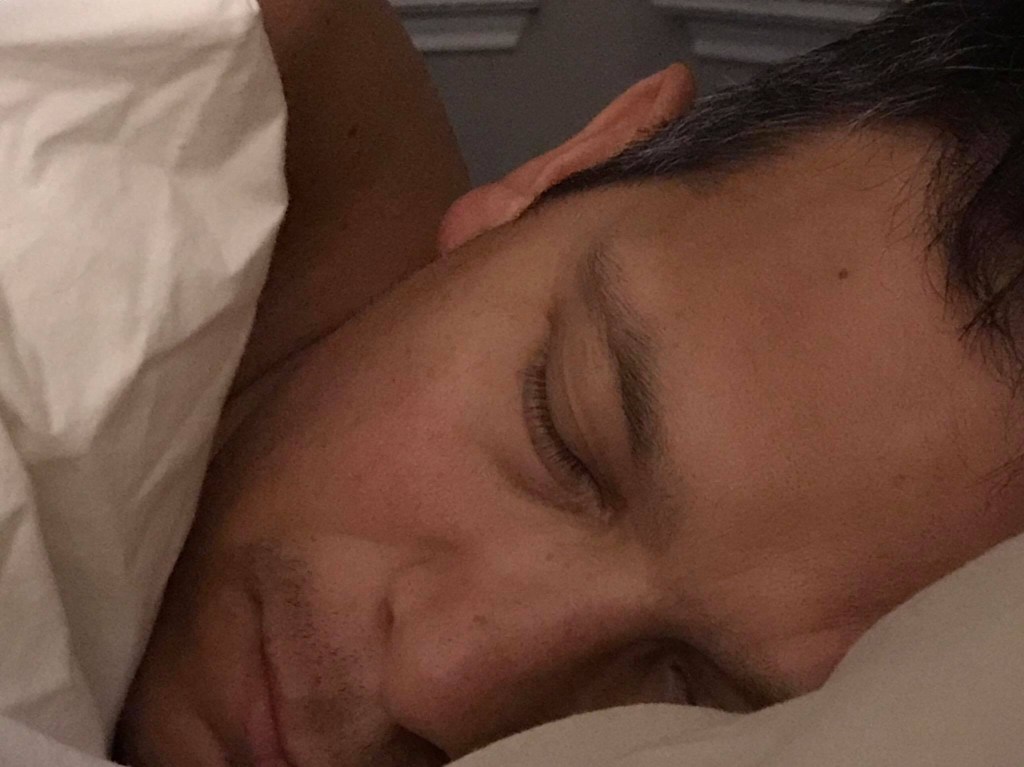
Through a veil of tears, I took a picture of Michael, because I wanted to remember him like that, in that moment. Peaceful. Vulnerable. Handsome. Alive.

Michael. August 2018.

After Michael died, I put together one of those Shutterfly albums with pictures of him, in which I included this photo. I come back to this one a lot, trace the contours of his face on the album’s page, just as I used to do in real life, in those tenderest of moments when he was still alive.

I downloaded that Tired Pony song that night. As much as I love the song, as gorgeous as it is, I don’t listen to it much, because I will always associate it with that clear-as-a-bell, prescient thought that sprang to mind: “He’s not going to make it.” That and the fact that all I want to do is get on the road and ride to Michael, but I can’t, because he’s not here anymore.

I knew it was bad when…(part 1)

Disclosure: Michael lost his battle with cancer in February 2019, but he had asked me to tell his story–our story–and so I am. You can read more about why I’m doing so here. When I originally started this blog, I wrote about events and feelings in the moment, because everything was happening so fast, and everything was chaos. Now that Michael is gone, and I’ve had the time to slow down and look back, all future posts will tell Michael’s story in a more chronologically correct order…or mostly so, no guarantees. They’ll also include some insights and commentary forged from hard-earned hindsight.

I’ll start with a refresher, so you don’t have to read all the previous blog posts if you don’t want to. Michael had barely turned 44 years old when this whole cancer shitshow started. We’d only been together for about two years and three months, married for a year and nine-ish months. Someday I’ll tell the story of our whirlwind romance, but not today. I explain the duration of our relationship solely to provide context. In the relatively brief time I’d known Michael, he’d always had back and hip pain, and neither of us worried about it. After all, that’s a consequence of a being a lifelong athlete, or at least that seemed a perfectly logical explanation (I mean, I had, and continue to have, years’ long battles with my IT bands and Achilles tendons for that very reason). But on Sunday, June 3, 2018, Michael experienced a spasm of acute lower back pain that ultimately never went away. In fact it spread around: to his hips, his shoulders, up his spine. The month of June was hell to start with and only grew more hellish. Fast forward: by July 12, 2018, Michael was diagnosed with stage IV prostate cancer. His prostate specific antigen (PSA) count was at 206, when it should have been below four, and the cancer had metastasized to his bones, including a spot beneath his left eye, on his orbital bone.*

Before we got the official diagnosis, though, there was a nearly two week long speculation period, during which the term “prostate cancer” was being bandied about pretty freely (my previous blog posts cover this, so I won’t rehash the details). But my first indication that things were bad, like, legitimately really bad was in the wake of the phone call with the GP who initially speculated Michael had cancer–an absolute angel of a woman named Dr. Angela Scalzi–who set us up with all the referrals and initial labs and scans we needed in order to take the next steps toward a proper diagnosis. During the phone call, Dr. Scalzi told us she was now out of her depth, that she could not make a prostate cancer diagnosis, but she was nearly positive that’s what we were up against. Further, Michael’s labs and scans indicated cancer in his bones. After we hung up from that call, I left Michael to rest, and changed clothes to go for a run. But before I left for my run, I did what you are never, ever supposed to do in the situation we’d now found ourselves in. I got on the internet. And that’s when I knew it was bad.

Me: What does 206 PSA count mean?

Internet: Yeah, that’s bad.

Me: 206 PSA count with enlarged prostate?

Internet: No, for real, that’s really bad.

Me: Prostate cancer metastasized to bones?

Internet: *sucks in breath* Prostate cancer 96% curable when caught early and confined to prostate, less so when spreads to neighboring organs, especially if cancer jumps to spine. If jumps to spine, five year survival rates 10 – 30%.

Me: *gulp* So we didn’t catch it early?

Internet: You’re fucked.

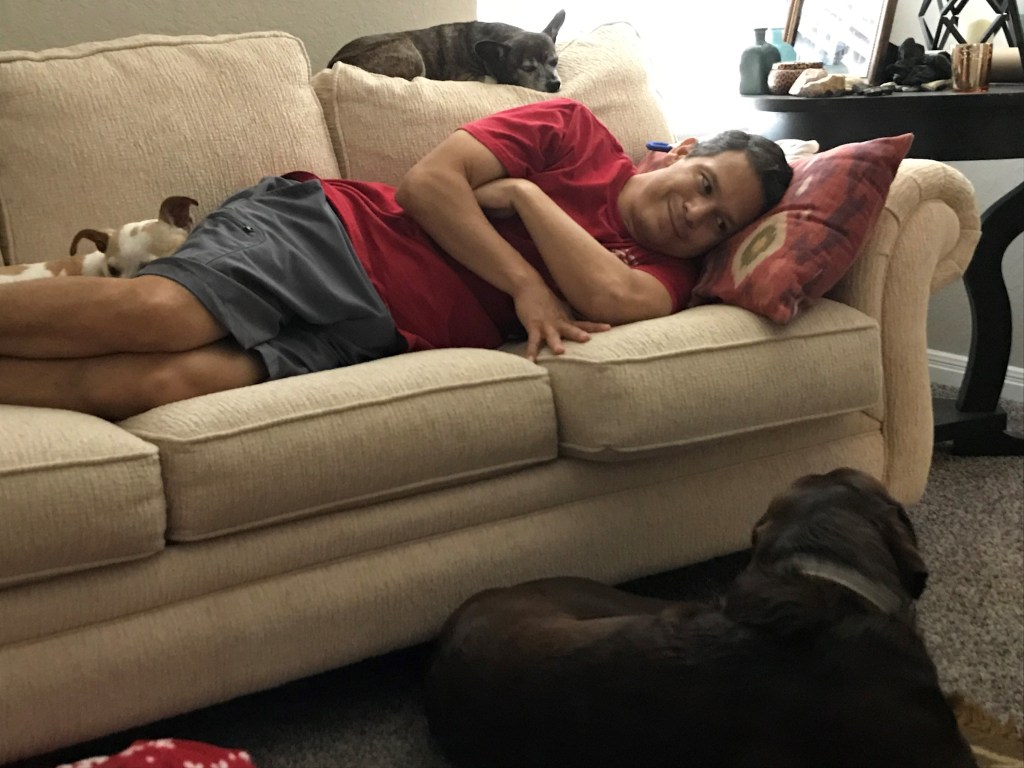
Michael with our dogs Sancho (l.), Bella (r.), Hermes/Big Dog (floor), right after we’d hung up with Dr. Scalzi.

*A few months before the back spasm episode in June of 2018–it might even have been a year before, I don’t know, but it wasn’t anything longer than a year–Michael had been at work, and he’d called me to check in, which he did every afternoon. He told me that he’d been getting some steps in, taking laps around the block outside work, and all of the sudden his left eye had gone blurry. Fearing it might have been a stroke or something, I asked if he had felt dizzy or noticed anything else was off, but his answer was “no”. Apparently the blurry eye thing cleared up on its own pretty quickly, and he never mentioned it happening again. That doesn’t mean there wasn’t a recurrence, but I’ll never know. Michael never wanted me to worry about anything. I wish I’d have asked if it ever happened again. I wonder if that little spot on the orbital bone was already there that day, so many months before.

Picking up where I left off, diagnosis day + 1,729

It is now April 2021. I long ago hit “pause” on writing this blog. I stopped writing for a lot of reasons, the main one being time, at least initially. Michael’s illness kept getting worse. My time felt better spent on caring for him—cooking, spending time with him, researching, cleaning, reconciling insurance statements against invoices, keeping my job. At some point during all of this, Michael’s brother, K, moved in with us for a few months. K is a kind soul, and it was nice to have him there with us. And then the holidays were upon us. Time just got away.

But the real reason I didn’t maintain the blog was that it was too emotionally draining to write.

I can’t sit here and tell you that no one tells you how emotionally, mentally, spiritually, physically, and financially draining a cancer diagnosis and subsequent treatment will be for both the patient and family and/or caregivers. I knew all this, Michael knew all this. But most guidance focuses on how financially draining cancer is. We took a hit financially, and I’ll cover that some other time. And the physical hit is obvious for the patient, less so for the caregiver (again, I’ll cover that some other time). But what you can’t properly comprehend—what no one really and truly talks about, because, in fairness, I don’t know how you quantify it—is just how emotionally and mentally devastating cancer is. I can think of no other time in my life when every single aspect of life, of my very being, was stretched so completely to the absolute limits of tolerance. If Michael were here to speak for himself, he would likely say the same thing, except he’s not here. He died on February 28, 2019 at 7:20 p.m.

No, I couldn’t bring myself to write. To keep writing about his illness and how we were dealing with it while he was deteriorating, to write while we were so far behind the eight ball, to write when to do so took such an emotional effort that I’d be too drained to work or to manage our house or to care for Michael—I just wanted to lay down and never get up after writing, even when it had once been my therapy—it was just too much. So I stopped writing.

Why pick it back up now, then? After all this time, after Michael has already passed, and more than two years ago, at that?

  • Because I believe our story is relevant to others fighting cancer, to their families and loved ones, and to their caregivers, even though our story didn’t have the outcome we so desperately wanted.
  • Because my own story continued after 7:20 p.m. on February 28, 2019, and I think there might be value in sharing that story with others.
  • Because Michael wanted our story to be told, so I have to, I am compelled to honor that wish, so that I can honor him.
  • Because to tell our story helps keep Michael alive for me.

Everything I write from here on out is based on (fading) recollection and the content of thousands of pages of Michael’s medical records. Even so, I will do my very best to tell the story of our journey. I have to.

The dentist

Another post that’s out of chronological order, but I need it to be out there, to be out of ME.

I have a massive fear of the dentist, and for good reason. In spite of consistently practicing good oral hygiene, throughout my whole life, every damn time I’ve gone to the dentist, there’s something or other that’s been fucked up with my mouth. It’s always painful. And, as an adult with shitty dental insurance, it’s always expensive.

The only good news is that, after 10+ years of just avoiding the dentist all together, I finally have a really good doctor here in San Antonio, whom my husband turned me onto, and whom I’ve been seeing for the last two years.

But, 10+ years of skipping out on regular check-ups, being a naturally high-strung individual who internalizes stress and, thus, grinds her teeth in her sleep like a fucking fiend, and also being a genetic mutant who still (up until today) has two baby teeth (molars)…my teeth are fucked up.

Back in August, on M’s and my anniversary weekend, I developed this pain in both one of my upper right molars, and the lower molar, right below it. Turns out, the lower molar is cracked, so I’ll need yet another crown (I already have two). The upper molar was one of my baby teeth, and that sucker had finally just given up the ghost. It was time to extract the tooth and install an implant.

I’d scheduled, canceled, and rescheduled this extraction/implant business three times, in part due to work and M’s medical stuff, but–let’s be honest–more because I was scared shitless.

But today was the day. My appointment was at 8:30 a.m. I am not a morning person, but I’d gotten up at 6:45. There was no reason for me to be late. Yet I was. By 15 minutes. Because I didn’t want to be there.

I got to the office, and they got me set up in the chair. I had expressed my terror to the periodontal dentist guy (not my normal dentist) and his assistant over and over during the prep process, but they did a really good job of calming me down, making me feel like it was all going to be okay. When I was sufficiently numb, they got to work. The doctor told me to wiggle my toes, squeeze my hands and let go and squeeze again, think happy thoughts.

Think happy thoughts.

Think happy thoughts…

WHAT HAPPY THOUGHTS???

Once again, as is my habit, apparently, we need to revisit a slightly earlier occurrence, one that happened last night, to help provide a little context.

Last night, I brought M some food from Pei Wei. At some point after we’d eaten, we’d gone back to our bedroom, where he’d asked me to massage the areas of his butt and side of his thigh that are in constant pain. After I’d finished doing this, he laid there on the bed, and I sat there next to him. I’ve mentioned in previous posts that we have four dogs. Two are smallish mutts I had before M and I got married. One is a 45 lbs. retriever/lab/something mix that had been M’s before we got married, whose name is Forest. The fourth dog is a man-puppy chocolate lab that just showed up at our door back in January of this year, and we kept him. He’s supposed to be my stepson, J’s, dog–and the dog really loves J–but the animal’s care falls mostly to M and me. That dog’s name is Hermes.

As we sat there on the bed after I’d given M that short little massage, he said to me, “When I go to Heaven, we can give Forest to my Uncle E.” I was a little taken aback, thought he might be kidding or something?

“What do you mean?” I asked.

“When I go to Heaven, you take the little dogs. J will take Hermes, and Uncle E can take care of Forest.”

I realized he was serious. He’s never talked about…this. About death.

“You’re not going to Heaven,” I said. I reached out to touch him.

“Okay, then, when I go to Hell–“

“No!” I said, “You’re not going anywhere. You’re staying right here with us,” I said.

We either stayed silent for a moment, or else we exchanged some sort of throw-away dialogue, I don’t recall. Eventually, though…

“I can take Forest,” I said. “He doesn’t have to go with Uncle E. I like Forest.”

“Three dogs is a lot of work,” M said. We’d had this whole conversation with him having his eyes closed, in pain, but having taken some CBD oil and waiting on a Tylenol 3 to kick all the way in. I don’t know how sound of mind he was, is what I’m getting at.

“I don’t mind three dogs. Forest is my friend,” I said.

“Okay, then,” M said. “When I go to Heaven, you can take the little dogs and Forest.” And that was the end of the conversation.

When he goes to Heaven…fuck. Fuck, fuck, fuck. I’m not there yet. We are NOT having that conversation yet. He is GOING TO LIVE, GOD DAMN IT!

Fuck…

Anyway, back to the tooth extractions and the happy thoughts. I had no happy thoughts. M is already planning for the afterlife. We have no plans to go anywhere, because we can’t make those plans. He is in constant pain. His PSA is going up and we’ve had a recent hospital visit (more on that some other time). I don’t know what becomes of me if I lose him, because I can’t ever imagine being happy again. I hate my job anymore, I don’t want to be there. There is nothing of material value that I can think of that brings me an ounce of joy. Thanksgiving? Christmas? Who cares? All colored over by this war we are fighting against an overwhelming enemy.

What the fuck could I possibly call upon as a happy motherfucking thought? In that moment? Nothing. Not a damn thing. I really thought I was going to panic, like I might have to just leap out of that dentist chair.

And then I remembered something I’ve been trying to work on. Breathing. Clearing my mind, and just focusing on the breath. I’ve dabbled in yoga, mindfulness. I’m inconsistent, and my brain won’t obey 99% of the time. But in that exact moment, I had nothing else, literally, there was nothing there to think about that could make me happy enough to get past the fear and anxiety of sitting in the dentist’s chair. All I had was the breath in that moment. And so that’s what I did: I focused on the breath. It worked. I still stumbled, my brain still got in the way, but it worked.

And then I paid $2215 for the whole thing and left.

I stopped to pick up prescriptions–antibiotics, bionic ibuprofen, some prescription mouth wash–and breakfast tacos for M. I’d barely gotten back in my car with the breakfast tacos when I started thinking about my tooth. That was a baby tooth, and it had been in my mouth since whenever it first showed up some 45 or 46+ years ago. That tooth had been with me through everything, through my whole life. It was one of the closest things–maybe THE closest thing–I’d had in my possession that qualified as something I’d had with me my whole entire life. And then I started crying.

I cried over a baby tooth. I’m 47 fucking years old, and I broke down over THAT. And even as I write this, some 10 hours later. I’m still sad. This emotional wobbliness…

Fuck this shit.

Pei Wei

I’ve been talking about this whole experience so far, chronologically. But I have to stop, to pause for a second, and interrupt how we got here to speak about what “here” feels like.

Last night, in spite of having more than enough leftover food from five days worth of making meals that walk a line between what I can get M to eat, and what he really should be eating, M didn’t feel like there was anything appetizing in the house for dinner. And he was getting hungry. And he’d had a bad day and was impatient and unhappy. For my part, I’m tired of throwing down hundreds of dollars every week (yes, every week) to buy the ingredients to make healthy meals and create leftovers, and then to spend my after work hours every night preparing those meals, only to have the meals and/or leftovers go to waste. Cancer is fucking expensive, even with insurance, and I’m growing increasingly frustrated being the only breadwinner in this house, with a very sick husband who is exhausted and in constant pain, a stepson who is old enough to contribute but doesn’t, and four goddamn dogs to feed and care for. I feel like a string that’s been pulled so taut it sings without strumming. I feel like I could snap in two any second.

I got online and ordered M some Mongolian beef from Pei Wei…even though we’re supposed to be eating a plant based diet only, but we’re not (for reasons I’ll cover another time), and that stresses me out. But he needs to eat, and he hasn’t been eating, so Mongolian beef it is.

Before I explain what happened next, I have to take us back just a little earlier in the evening. I was driving home from work and I stopped at a Shell station to buy some beer, a local IPA I like. I walked into the Shell. It’s a nice Shell, less than a year old. There was music playing, as there always is in these places. But the song playing was by a band called ‘Til Tuesday, fronted by Aimee Mann. They were popular in an indie sort of way (save for one mainstream hit) back in the mid-eighties, when I was a teenager. The song playing there in the Shell was obscure and was called “Coming Up Close”. You’d have to be a fan of the band to have ever really heard of it, much less know every lyric. But I was a fan, and I had heard of it, and I was singing the song softly to myself as I picked out my beer. Here’s the thing: the lyrics are beautiful, haunting, and ultimately sad. It was a song I’d sort of forgotten about until this past June when, I don’t remember why, something triggered me to download a bunch of ‘Til Tuesday songs on my phone, and I’d been listening to them, this one included, on the regular. But only if I could handle it, because the songs are emotionally charged and, while gorgeous, tend to wear me down. I have to be ready to hear them, in a good place to experience them. When I walked into this Shell and heard this song playing, I was totally unprepared, emotionally, to hear it. Even so, it was pleasant, but it got to me a little. I’m already emotionally wobbly these days, so I’m vulnerable to unexpected emotional hits.

I got in my car, listened to NPR like I always do, drove home. No biggie, really.

Back to Pei Wei. I didn’t place the Mongolian beef order until after 8 p.m., and I needed to get some work done. I sort of lost track of time working, and didn’t realize until it was nearly too late that Pei Wei closed at 9 p.m. It was 8:42 p.m. I started driving, but first I put on a playlist of songs I’d downloaded back in June, which included all those ‘Til Tuesday songs. “Coming Up Close” is lovely, and earlier in the night it had put me in the emotional state to “receive”, if you will, other songs with similarly emotional lyrics, but I didn’t want to hear that song again right then. I wanted to hear “Looking Over My Shoulder”. That one gets me, too, but it’s less about the lyrics, more about the music and about the passion Aimee Mann sings with. I usually try to sing with her, even though I sound like a wounded animal, and last night was no different. Driving in the blackness along Evans Road, I sang.

But as I drove, I also hit every stoplight, and there’s construction, so I got turned around in the dark, trying to figure out where to turn in to the strip center where the Pei Wei lives. Driving on a busy highway (that I should never have even gotten on, but, fuck, I was turned around), I tried Googling directions to the goddamn Pei Wei. Google decided that I was on foot rather than driving. It was 8:54. I couldn’t drive 60 miles an hour in construction in the dark and switch my phone from walking to driving directions. Weirdly, it wasn’t about anyone’s safety, it was that I just kept thinking 1) I have to get food or M will be pissed; and 2) we don’t have the money to pay for traffic tickets or wrecks right now.

And that’s when I lost it. Just fucking lost it. I started screaming at the top of my lungs. Not horror movie, girly screams. Angry screams. Screams that turned my throat ragged. I screamed, yelled “fuck!”, screamed even more, yelled even more. I started to think I might never stop. I just kept screaming. I wanted to scream on top of screams.

I did stop screaming. I made it to Pei Wei at 8:58. The doors were locked, but there was a little girl behind the counter, cleaning. I yanked at the doors harder than I needed to, harder than I should have. The girl let me in. I picked up M’s order and got back in my car. I considered screaming some more. I wanted to, but I was afraid I’d never stop.

I put Aimee Mann on again, had her sing “Looking Over My Shoulder” to me again. I turned the volume up. I sang with her. I turned the volume up more, and still more. I yelled the lyrics with her. I couldn’t hear myself, the music was so loud. I yelled the lyrics until I cried, and then I yelled them some more between sobs. When she was done, “Burn It Down” by AWOL Nation came on, and I didn’t sing, I just kept the volume up so loud that I couldn’t hear the thoughts in my brain anymore.

By then I was home. I pulled my shit together and brought M his Pei Wei.

Course of treatment for stage 4 metastatic prostate cancer – the western medicine version as applied to my husband

And now a time out to talk about how M’s stage 4 prostate cancer is being treated.

First, no one has ever told us that M is stage 4. No one ever explained his Gleason score to us (7, though I don’t know even now if it was 3+4 or 4+3), or if cancer was present in all 13 cores of the needle biopsy he underwent (yes). Truth be told, 3+ months into this, and I still don’t fully understand the lingo of prostate cancer diagnosis. I’m not sure it’s relevant, anyway. That the cancer has spread to his bones (bone metastases), which are considered far off organs, is bad and from all the literature I’ve read, and it means he’s stage 4.

The cancer in his bones is in his pelvis, a couple of vertabrae in his lower spine, a few more vertabrae between his shoulders, in his lower ribs, and then there’s this weird hot spot below his left eye, in the orbital bone. The pain he had been feeling in these areas (minus the eye) was due to essentially having broken bones. The bones, themselves, don’t have nerve endings, but they do have a protective sheath around them that does have nerve endings, and when the bones are inflamed–broken–they swell and irritate the sheathing. There is nothing to be done about the pain, it won’t go away until the bones heal, so you just have to manage it. A subsequent visit with the urologist, Dr. Hudnall, taught us that M’s lowered red blood cell count was due, in part, to his bones having been damaged, and those damaged bones couldn’t kick in to produce the red blood cells they’re supposed to supply.

So, the diagnosis is stage 4 prostate cancer with bone metastases. What’s the treatment plan? First, let’s cover what ISN’T part of the plan. M is not a candidate for prostate removal surgery, because the cancer is already outside his prostate, so removing the prostate is pointless. As I understand it, radiation is very selective, only targeting those areas where the cancer has been observed. But because the cancer has spread, there’s no good way to know whether subjecting him to radiation would kill off all the cancer, or if it might miss a spot. Chemo is still an option, because that’s a whole body therapy, but it’s not the right place to start, not until other therapies have been ruled out as ineffective or no longer effective.

In M’s case, the first line of defense is androgen deprivation therapy (ADT), also known as hormone suppression therapy, also known as drain all the fucking testosterone from his body. Why this? Because prostate cancer eats testosterone, which is the male sex hormone, or androgren (by the way, all cancers like sugar, too, but I’ll cover that some other time). So, remove the testosterone–the androgen–and you remove the main food source for the cancer cells. And how do we go about this? Well, there are two places where testosterone is made: in the testes, and then in little bits elsewhere in the body (the latter is the reason that females have testosterone in their bodies, even though we don’t have testes). The vast majority of testosterone is produced in the testes, so the first target of ADT is to shut down testosterone production there. Degarelix (brand name Firmagon) is the fastest way to do this. It works inside of 24 hours, just shuts down all testosterone production in the testes, and drops testosterone to near zero in the body. But it doesn’t do so permanently, it has to be administered every 30 days (apparently men have hormone cycles similar to women, every 28 days or so, but I haven’t done all the research on that, so I’ll shut up about it for now).

The side effects of ADT in general, and degarelix in particular, are numerous and unpleasant. You can read about them here and here.  Every patient will be different, and I can only speak to M’s experience. For him, degarelix caused pain at the injection site (which is his belly) which was intense and persistent, but subsided after a couple of days.

It also knocked him on his ass, wore him out more even than he already was. And it made him very, very emotional. I remember, in the day or two after his first shot, his reaction to something I conveyed to him from a very close friend of ours with whom we were supposed to go on a trip to Mexico City in a couple months’ time. I told M that I had talked with our friend about the trip, and that she and her husband still really wanted to go, but that she suggested we just modify our itinerary and take it really easy. She and I both thought that was a good idea, that it gave us something to look forward to. But M’s reaction to keeping the trip on the calendar was anger and hurt. He didn’t understand how our friend could be so insensitive and thoughtless. Didn’t she understand that he had cancer all over his body, that he was in pain, that he doesn’t even speak Spanish and didn’t want to go to Mexico in the first place (I should note, when we booked the trip–before we knew he had cancer–he was totally on board). I calmed him down, explained the logic, and he relaxed a little, but this was so unlike M. I also remember the Thursday after the first injection–and the “official” cancer diagnosis–coming home from work and finding M in bed, crying. I laid down with him and put my arms around him. And he just cried. He apologized for the tears. But how in the world could anyone blame him? No testosterone, which has to be the weirdest feeling, a cancer diagnosis, constant pain and exhaustion. Fear. How do you NOT cry? Beyond being very emotionally wobbly, the ADT also makes M tired, so, so very tired. He has hot flashes, which can be intense. And his libido is all but gone. It also makes his brain foggy, which makes it so that he’s not always comfortable driving, and I notice that he has to search for words sometimes, there’s an occasional stutter, and he’s forgetful.

In addition to ADT, and in part because of it, M is on bone density building medication. That the cancer has spread to M’s bones means that he’s already experienced bone degradation in the spots the cancer has taken up residence. But just as women lose bone density with age, and more specifically, with a drop in estrogen levels, so, too, do men lose bone density without testosterone. So to manage that side effect, M is on Xgeva (generically, denosumab). Like the degarelix, M gets a monthly shot of Xgeva to help repair/replace damaged bone tissue and keep it from degrading further. His hips are of particular concern, since they receive the full impact of walking and standing.

Just like the degarelix, the Xgeva shots wipe him out, just not as badly. Xgeva side effects can be found here.

Lastly, Dr. Hudnall prescribed M Zytiga (generically, abiraterone acetate). Remember how I said that testosterone is produced in the testes, but also in small quantities in other parts of the body? Zytiga targets the production of testosterone in those other parts of the body. As I understand it, the drug works directly on the pituitary glad. The pituitary gland is sort of like central command for directing hormone production. The pituitary sends messengers out to the parts of the body where hormones of all different kinds are produced, and it tells those body parts, “Hey, make some more of X hormone.” Zytiga functions by telling the pituitary, “Hey, girl, maybe just stop telling folks to make that testosterone all together, m’kay?” When the pituitary follows those instructions, all the testosterone produced outside the testes ceases to get produced. And remember how I said that prostate cancer eats testosterone? Well, between degarelix and Zytiga, in theory, there should be no testosterone in M’s body…if he’s taking both meds.

Which he’s not.

Zytiga’s side effects (found here) scare M, to be blunt. He already feels like shit, and so the thought of adding yet another drug that will make him feel worse is unacceptable to him until all other non-drug treatments have been tried, specifically, homeopathic treatments (i.e. supplements, diet changes, infrared sauna, etc.; I’ll cover what we’re doing on this front in a separate post). So, we have a bottle of Zytiga in our cabinet right now that has gone unopened since its arrival in our house two months ago.

An important note about Zytiga. Up until March of 2018, Zytiga had not been approved by the FDA for concurrent use with drugs like degarelix. Zytiga had previously only been approved for use after degarelix ceased to be effective (which is ultimately what happens with degarelix–cancer is smart, it knows how to adapt and work around the system). But presumably studies have shown that concurrent use of degarelix and Zytiga (or Lupron and Zytiga) can actually help lengthen survival time.

M no longer had blood in his urine when we went to see Hudnall in August. His PSA also dropped from 206 to 16 in about a month’s time. By September, his PSA had dropped to 5.8. During this time period, we began the transition away from sugar/carbs, and conventionally grown fruits and veggies. We ate all organic eggs, fish, and chicken and all but cut out any red meat or processed foods. M eased up on beer consumption and increased water intake. He had long since stopped with Red Bulls, and he didn’t really have a thing for sodas (save for the occasional Mexican Coke). He began taking supplements, starting with calcium and vitamin D3. I also started making this smoothie from hell every morning. Twenty-nine ingredients, if we had everything on hand to make it, but never fewer than 20 ingredients. And there was exercise and everything else M was doing. I’ll cover all of that separately. The point is that we thought we had made changes and were really nailing this.

But in spite of everything, on M’s last round of labs in mid-October, his PSA had gone back up to 33. Hudnall practically begged M to get started on the Zytiga. The words Hudnall used that hit me, and the way he delivered them: “I know you’re still trying to get your head around this, but this is the real deal.”

During this same visit, Hudnall moved M to Lupron injections, which, in M’s case, if he gets on the Zytiga, only need to be done every six months. Lupron is another ADT treatment, another version of degarelix, except it acts a little differently. I still need to research it further.

In summary, then, we started with degarelix and Xgeva for the first three months. As of October, we’re on Lupron and Xgeva, but M is supposed to add the Zytiga. When I asked M if he really would start taking the Zytiga, he said he would, but only after the next round of blood tests, because he wants to see if the homeopathic options he’s undertaken have made a difference. I said I would post more about homeopathy and I will, but for now, suffice it to say, M is taking a boatload of supplements, ozone therapy twice a week (think Lance Armstrong blood doping), vitamin C injections twice a week, PEMF (magnetic pulse therapy), and we’ve now moved to a vegan diet, save for a tiny bit of butter now and then.


July 16

On Monday, July 16, 2018 we received the official cancer diagnosis from Dr. Hudnall. Technically, the cancer was diagnosed on July 12, the day of the biopsy, but we didn’t see Hudnall until the following Monday morning.

It has been over three months since we received the diagnosis, and almost as long since I last wrote on this blog, so I don’t remember much about that doctor visit. The only things that stand out are, first, that M got his first degarelix (Firmagon) injection–two shots administered to the belly). I don’t remember what Hudnall said. I don’t remember what the nurse who administered the injections said, or even which nurse it was. The only other thing I really remember was saying something lame to M while he was getting the shots, something like, “You’re doing good, babe.”

The checkout process was a blur. We needed to schedule a follow-up degarelix injection, and an injection of the bone density meds (Xgeva), and he would need to get labs.

I don’t remember the drive home. I do remember that the shots drained him, and his belly hurt for days at the injection site, like, extremely tender to the touch. I think one of the dogs inadvertently stepped on his stomach at one point.

But, yeah…July 16.

Biopsy day +1

I had intended to go into work on Friday, July 13, but I felt so bad for having more or less ignored M the day before in favor of cooking–dealing in my own way with my stress and fear–that I had decided Thursday night that I would tell my boss I was working from home on Friday.

There is such a conflict that happens. I want to be at home, I feel like I NEED to be at home, but there’s a lot happening at work, and my team is short-staffed, and our whole leadership team in our company has turned over, so I’ve got relationships to build and work to do to prove myself…I feel like I NEED to be at work, too.

By Friday morning, I was so stressed out about the prospect of staying home that in my mind, I’d made a compromise: go to the office in the morning, make an appearance, ensure everything is moving forward, then take off after lunch to spend the afternoon with my husband.

I got out of bed, got ready for work. M got up to use the restroom (we have separate bathrooms, it just works better that way) and passed by me in the kitchen on the way. He was in the bathroom for a long time, way longer than normal. After a while, I heard him calling for me. I went to the door of his bathroom.

“I need you to call the number they gave us yesterday,” he said. “I can’t pee.”

I called the number they’d given us at the surgery center and told the phone-answering lady what was going on. She asked if we could be there to see Dr. G before 9:30. I told her we could.

M and I got dressed and got in the car. The look on M’s face was a mix of worry bordering on fear, and extreme discomfort. My own heart was racing. Turns out, Dr. G normally offices out of Stone Oak, which is much closer to us than the office where Dr. H is, so that was positive. But due to traffic, Google had us take the back roads to get there. I had no idea there were so many bumps and potholes on those roads until we took that drive. God damn, San Antonio, fix the fucking roads! I did everything I could to avoid jarring M–between a full bladder and the pain he already was in–but it was impossible not to hit a few bumps, and he winced every time.

I dropped him at the door of the urology center and tried to find a parking spot. Pause here. I really would like for someone to explain to me the logic behind “Compact Only” parking spaces. NO ONE DRIVES A CAR THAT SMALL! It felt like it took all of eternity to find a spot, but eventually I did. The whole time I was practically breathless.

Once inside, it took about 10 minutes to be called back to the examining room. Did you know they make a handheld ultrasound wand that can detect how full your bladder is? Well, they do, and the nurse ran it across M.’s belly and pronounced his bladder full.

The nurse went out and Dr. G popped in right after that. There would be a catheter involved. I have no idea what else he said.

We had to move exam rooms. A different nurse came into that room. I remember that she was pretty in a scary way and that she had full-blown, drawn-on chola eyebrows. She had M take off his shorts and underwear and lay back on the examining table. She started pulling supplies out of cabinets: an empty, hospital pink container, a big bottle of saline solution, other stuff. The piece de resistance, though, was a clear plastic tube that seemed much longer and thicker than it should have been for what I assumed it was about to be used for.

If you are ever offered a front row seat for watching an unsedated man have a catheter inserted, opt out. If you are ever an unsedated man having a catheter inserted, try not to be that man.

The exam room we were in was the one closest to the waiting room. There was a standing lamp with an extension arm on one side of the exam table, and a hand rail on the other side. M grabbed both violently and howled as the nurse began inserting the catheter. If I’d have been a patient in the waiting room, I’d have said, “Fuck this” and cleared out the second I heard the racket coming from our exam room.

The nurse paused for a moment, M asked if it was in. “No, I still have to get past the prostate,” she said.

“Oh, fuck,” M said and laughed the way you laugh when something’s not funny at all. He gathered himself.

“Okay,” he said, “let’s do this.”

I got up from the chair I’d been squirming in, and came to M’s side. I tried to get him to hold my hand and squeeze it instead of the lamp. Lamp won out.

She finally got the catheter all the way into the bladder, and then slowly but steadily, the pee drained out. I couldn’t see at this point, since I was facing M and had my back slightly turned away from the nurse and this whole draining procedure. The nurse commented idly on the volume of urine. There was a lot. She got another container.

At some point I turned around and looked. The urine was the color of red wine, and not like a happy, light pinot noir, but instead heavy and dark.

After all the urine had finally drained out, the nurse began the process of irrigating the bladder. I don’t know if anyone ever straight up said, “M, you couldn’t pee because of blood clots in your bladder,” but it was pretty clear that’s what the problem was. So rinsing out the bladder was the logical step to take to ensure all the clots got cleared out.

Irrigating the bladder involves using a syringe to pump saline water back up the catheter and into the bladder, and then drawing it all back out. I don’t know how many times the nurse did this, but several for sure. Each time she’d push the saline up into M’s bladder, you could see M’s discomfort.  I asked if he was okay, he said it just made him feel like he needed to pee again. Logical.

I don’t know at what point these medical exam situations cross the line from awkward to ridiculous, and then cross another line to sort of the mundane equivalent of standing in line with strangers at the post office and talking about the weather. But at some point during the irrigation process, I asked the nurse, “So, how long have you been in this field?” Turns out, over ten years, but she’d started as an ER nurse. She’d pretty much seen it all.

At one point M said, “I always thought I’d enjoy my first threesome.” We all laughed.

The nurse finished up, and gave M a container she told him to pee into. As he got off the exam table, I offered him his shorts and underwear to put back on.

“I think we’re past that,” he quipped.

The nurse stepped out. He peed into the container she’d given him. I looked away, but when he finished, he showed me the contents of the container. Clear enough pee, but a bunch of blood clots resting at the bottom. “Damn,” was all could say.

We left after that, with instructions to stay hydrated and take it easy. Nothing else happened that day, other than M’s dick hurt, because, duh. Hell, my dick hurt, and I don’t even have one. One long-running outcome of the day did occur, and it stuck around for many weeks. M refused to take any painkillers. The night after the biopsy, he’d taken a Tylenol 3. Normally M would get up several times a night to pee, but he didn’t do so that night, after he’d taken the pain meds. His theory was that, because he didn’t keep peeing and in doing so, keep clearing his urethra of blood clots, he developed a clot too large to pass. So, even though his body is in pain, he doesn’t want to take anything that will relax him too much and let him sleep too long. I don’t blame him, I think we were both traumatized a little by that visit to the doctor, but the pain he’s in…